My body started changing in ways I couldn't ignore, and it was confusing and frustrating.
Getting a full or good night's sleep became impossible. My weight wouldn't budge. My joints ached even though I hadn't strained or injured myself in any specific way. My moods were... let's just say "interesting." And everywhere I turned, the advice being given to midlife women about exercise seemed to fall into a few tired buckets.
"Do high-impact exercises to protect your bones."
Or
"This is just how it is for midlife women."
None of that felt like the whole story.
Why "just do high-impact" falls short
On paper, the advice to run more, jump more, "pound the pavement for bone density" makes sense in a way. But for midlife women, this advice can be a disaster.
By the time many of us hit perimenopause, our knees, hips, and lower backs already have something to say. Years of life, work, old injuries, or just existing add up. Piling a bunch of jumping and pounding on top of that doesn't always feel empowering. Sometimes it feels like punishment.
On top of the joint pain you may be experiencing, estrogen levels are also quietly dropping in the background. This slow decline in estrogen can accelerate bone loss.
How I started barre
In the middle of trying to reconcile my supposed "new normal," barre classes quietly walked into my life. It wasn't a carefully thought-out decision. It was more like, "Everything else in my life has changed. Why not this too?"
I had changed my job. I had changed the city I lived in. I had lost a sense of who I even was anymore. The way I was moving my body started to feel like one more thing that no longer fit. Getting myself onto my yoga mat felt like work. Not in the good, disciplined way, but in the "this is just another thing I'm failing at" way.
So I did what a lot of us do when we're feeling a little lost: I went backwards before I moved forward. I reverted to my group-fitness-gym-girl days.
Somewhere in the tangle of old emails and app subscriptions, I remembered that I still had access to a barre fitness app I'd signed up for years earlier. I had grabbed an annual membership deal back then and been grandfathered in at a low price. I could never quite make myself cancel it because it was such a good deal compared to what it costs now.
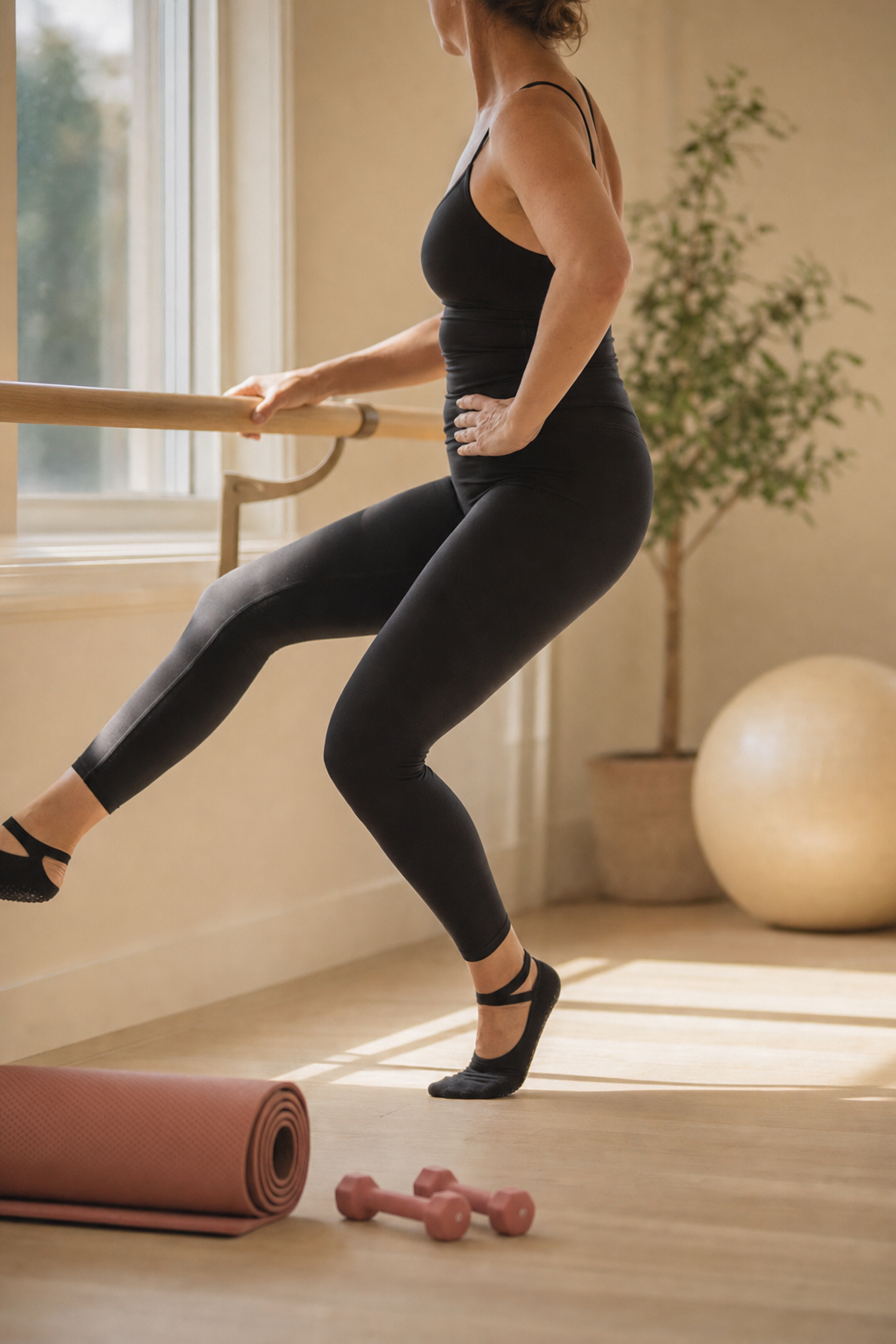
So one day, I said, "What the hell," grabbed my little pink pair of two-pound weights, a ball, and a kitchen chair. I opened the app, found a "basics" class, hit play, and proceeded to get my ass handed to me over the next 55 minutes.
I could not believe how hard the workout was. How much I sweat. How many breaks I needed. How much I shook. How much I struggled to simply stick with it and finish the class. And also how much, against my better judgment, I wanted to do it again the next day and get better at it.
Over the next year, those barre classes did much more for me than I ever expected. I got stronger and leaner, more toned in a way that felt like my body, not someone else's. My clothes fit differently. I moved differently. The exact numbers and sizes are less important than the feeling, but if we were sitting together having coffee, I could tell you exactly how much changed and where.
More important than the inches and sizes, though, was this: barre became a regular part of my rotation. It felt like a workout my body could actually meet. Not just when I was feeling strong and motivated, but on regular Tuesday mornings when I was tired and firmly planted in my middle-aged-lady feelings.
And as I kept moving through all sorts of internal and external body changes, I realized that this type of exercise was one of the best things I could have been doing for my body all along.
Estrogen is not the enemy
For years, I had absorbed the same story a lot of women had been told: estrogen is the enemy. Estrogen was the thing that caused cancer. Estrogen was something you shouldn't "mess with." I was afraid of HRT, afraid of anything that looked like "adding hormones" to my body and convinced it was not the right decision. I was afraid of listening to my body even when I really knew something felt very off.
Estrogen is not just a sex hormone. Estrogen is one of the main reasons our bones stay dense, our joints stay mobile, and our tissues stay supple. Estrogen supports our hips and shoulders and spine. It affects our ligaments, our tendons, our brain, our sleep, our mood. It touches almost everything that makes our bodies feel like our bodies as women.
When estrogen starts to decline in midlife, a lot of things start to change: bone density, joint mobility, muscle mass, how and where we store fat, and the risk of things like osteoporosis, frozen shoulder, hip issues, and a long list of "that's just how it is when you get older" problems we've quietly accepted for generations.
The more I have learned, the more I've realized that two things can be true. My body needed functional, consistent, weight-bearing movement to protect my bones, joints, and muscles. I also needed the right medical support and treatment plan from a doctor who actually understood menopause instead of fearing it or taking a blanket approach.
I'm not here to tell you what to do with your hormones. I am not a doctor, and this is a blog post, not a medical journal.
I am just a woman who believed a lot of things for a long time that turned out not to be the best action plan.
Making barre classes a part of my workout routine has been very helpful for this season of my life. It may be something you'd like to take a look at too.
Reason 1: Bone health without the joint pounding
One of the harsher truths about perimenopause and menopause is that our bones are listening to our hormones. As estrogen declines, bone density naturally drops. The risk of osteopenia and osteoporosis goes up. Hips, wrists, and spines become more vulnerable than they used to be.
This isn't about wearing a particular size. It's about preventing falls and fractures and preserving our long-term mobility.
For years, the loudest answer to this very real and scary problem was to take up jogging, running, or another higher-impact form of exercise. The problem is that for a lot of peri- and menopausal bodies, pounding the joints into submission is not realistic. The knees, hips, and lower back that have carried you through decades of life may already be shouting their objections.
Barre offers another way to talk to your bones.
Picture a simple sequence at the barre: you're standing in parallel, holding on lightly, bending and straightening your knees in small squats. Then you lift your heels and lower them, over and over. Nothing flashy. But you're loading your legs and hips against gravity. Your muscles are working, and your bones are paying attention.
You stay on your feet. You move with control. You invite your body to remember, "Hey! We still use this. We still need this." And you get to do it without the jarring impact of pounding the pavement.
You don't need hour-long classes six days a week. Even two short barre sessions a week, fifteen to thirty minutes each, are enough to begin sending your bones the message that they matter.
Reason 2: Lean muscle for metabolism, strength, and confidence
Another fun fact about midlife (and by "fun" I mean not fun at all) is that we naturally lose muscle mass as we age. Less muscle means a slower resting metabolism, more blood sugar swings, less strength for everyday activities, and more of that unsettling feeling that your body doesn't quite feel like your own anymore.
Barre helps here in a very sneaky way.
Most barre classes use light weights or just your own body weight, high repetitions, and those isometric holds that produce the infamous barre shake, especially in the glutes, thighs, and hamstrings.
These muscles are incredibly important for walking, climbing stairs, and staying balanced. Over time you're developing greater functional strength.
You'll start to notice that getting up and down from the floor feels easier. Stairs feel less like an event. Carrying groceries or a heavy laundry basket doesn't wind you the way it used to. Your muscles just generally feel more responsive and available when life asks something of you.
Reason 3: Joint-friendly, pelvic-floor-aware, and balance-boosting
Peri- and menopause can make a lot of traditional workouts feel suddenly hostile. Joints ache more. Old injuries feel aggravated. Pelvic floor symptoms like leaking, heaviness, or prolapse worries can turn high-impact cardio or crunch-heavy classes into something you dread instead of something you look forward to. The fear of making things worse is real.
Because it's low impact and alignment-focused, built around controlled ranges of motion, barre offers a middle path. You can strengthen your knees, hips, and ankles safely. You can work your glutes and core in ways that actually support the pelvic floor rather than straining it. And you can practice balance and single-leg work with built-in support instead of feeling like you're about to topple over.
Holding on to a barre or a kitchen chair means your nervous system can stop clenching its way through balance work and actually focus on alignment. Instead of thinking, "Don't fall, don't fall," the whole time (hi, yoga tree pose in the middle of the room), you can pay attention to how your knee is tracking, whether the four corners of your foot are grounded, and whether or not your spine is long and your core is engaged.
So much of staying mobile later in life comes down to very simple things: being able to catch yourself if you trip, having the strength to step over or around things, reaching and twisting without fear. Barre quietly trains all of that. You don't have to do anything complicated. Simply standing on one leg at the barre, or doing small leg lifts and side work, builds the stabilizing muscles that keep you upright and a little less wobbly in the rest of your life outside of taking class.
Reason 4: Mood, sleep, and nervous system support
Perimenopause and menopause symptoms are not just about hot flashes.
They can also look like anxiety that seems to come out of nowhere, irritability and low mood, night sweats, 3 a.m. wake-ups, and that awful feeling of being wired and tired at the same time.
Moving your body won't fix everything, but the right kind of movement will speak to your nervous system in a language it understands. I found barre to be a form of exercise that spoke this language because it landed in a bit of a workout sweet spot. It required enough effort that I felt like I got sweaty, elevated my heart rate, and worked hard, but not so intense that I felt like I had completely destroyed and depleted myself.
I almost always finish class feeling more in my body and quieter in my mind. For better sleep, this matters. For a more regulated mood, this matters. For the day-to-day experience of living in a body that is changing, this matters.
Reason 5: Mind-body connection and a sense of community
Barre is not just tuck and squeeze and pulse. It's also a coordination practice. Your upper and lower body are often doing different things, so your brain and body have to talk to each other.
It's a posture practice: lifting through your spine, opening your chest, remembering that your head is not supposed to live in front of your shoulders all day. It's a focus practice, too, because you do have to remember sequences and adjust your form as you go.
Over time, this different style of mindful movement sharpens your sense of where you are in space, how you're standing, and what your body is actually doing. You start to notice it in small ways, like how you sit at your desk or how you stand in line at the store.
For me, barre sits right alongside yoga and walking as part of a bigger mission: helping women feel more at home in their bodies instead of feeling like they're in a constant fight with them.
How barre can fit with what you're already doing
You do not have to drop everything and become barre-obsessed to get the benefits.
For many peri- and menopausal women, a week might eventually look like two short barre sessions, a couple of walks, and one or two yoga practices for nervous system support and mobility. If it makes sense for you, you may even consider adding a heavier strength day with weights or kettlebells. But remember, none of this has to be intense or extreme.
A few things before you start
The things I've shared in this post, and in my blog in general, are things that I've learned and that have worked for me. Please do your own research and speak to the medical professionals in your life before embarking on any major changes. We are all on our own journey.
I am not a doctor. I am not giving hormone advice. I am not telling you what type of fitness routine you should do either. Though I am a fitness professional, we haven't met. I don't know your body or what past injuries and history with exercise you are bringing with you.
If anything I've shared in this post resonates with you, I encourage you to start simple and to start where you are. Talk with a medical professional who specializes in midlife women's health. You deserve more than "this is just aging" as an answer. Or try out some beginner-friendly barre exercises at home with a kitchen chair and light weights or no weights at all.
Notice how your body feels during and after. Do you feel a little more grounded? Do you feel your legs and hips in a new way? Do you feel just a tiny bit more "in" your body, even if you were a bit wobbly?
You're not alone. I've been there too.